

Can I Sell My Long Island House With Mold or Water Damage?
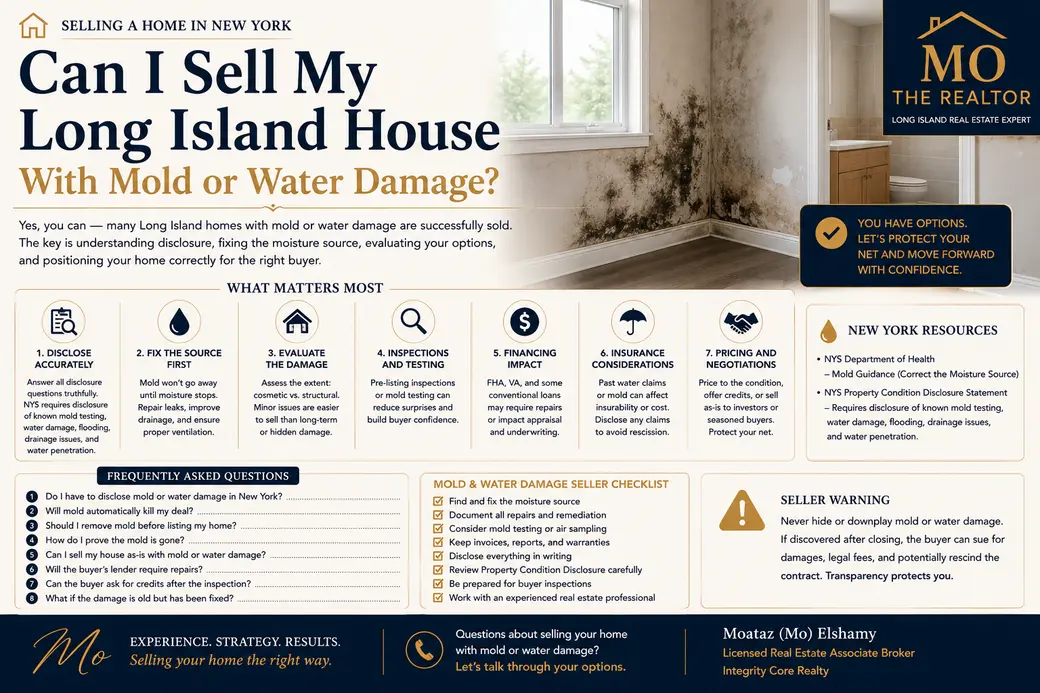
You are preparing to sell your Long Island home, but there is a musty smell in the basement, an old ceiling stain, visible mold near a window, or a history of water entering during heavy rain.
Should you test for mold? Must you remediate before listing? Can you sell as-is? What if the leak was repaired years ago but the staining remains?
Mold does not automatically make a home unsellable. The real transaction risk is unresolved moisture, unclear history, incomplete repairs, and waiting for the buyer’s inspector to discover the problem.
Mo’s quick answer: Yes, a Long Island home can often be sold with prior water damage or mold concerns, but the seller should first identify and correct the moisture source, document what happened, determine the realistic scope, and disclose known conditions accurately. New York health guidance states that moisture control is the key to mold control and that routine mold testing is generally not recommended. The strongest strategy is evidence-based repair and documentation—not cosmetic concealment.
Mold Is Usually a Moisture Problem First
Mold spores exist naturally in the environment. They grow indoors when moisture remains on suitable materials.
Common Long Island moisture sources include:
- Roof or flashing leaks
- Foundation seepage and basement moisture
- Plumbing leaks
- Poor grading or drainage
- Window and siding leaks
- Condensation around air-conditioning equipment
- Bathroom and kitchen ventilation problems
- Storm or flood water
Can You Sell a House With Mold?
Yes. The practical question is how the condition will affect the buyer, inspection, lender, insurer, contract, and price.
Small and localised
A limited area with a clearly repaired moisture source may be manageable with proper cleaning and documentation.
Large or recurring
Extensive growth, repeated leaks, hidden moisture, or structural damage usually requires specialist evaluation.
Historic and repaired
Old staining may still concern buyers unless the seller can show what caused it and how it was corrected.
Active water damage
An unresolved leak or wet basement is more serious than the visible mold because the condition can continue worsening.
Does New York Require a Mold Test Before Selling?
Generally, no statewide rule requires every seller to perform mold sampling before listing.
New York State health guidance says routine mold testing is generally not recommended because visible growth and moisture conditions often provide more actionable information than identifying the species of mold.
When a Professional Assessment Makes Sense
- The affected area is extensive
- The source is hidden or disputed
- The problem keeps returning
- There is suspected growth behind walls or ceilings
- The home experienced significant flooding
- Occupants report health concerns
- The seller needs independent documentation
- The buyer’s inspector has raised a serious concern
New York licenses mold assessment and remediation professionals. When professional work is appropriate, verify the contractor’s licence and role.
Should the Seller Remediate Before Listing?
| Strategy | Potential advantage | Main risk |
|---|---|---|
| Correct and remediate before listing | Reduces uncertainty and strengthens buyer confidence | Cost, time, and possible discovery of a larger issue |
| Obtain an assessment first | Defines the source and realistic scope | The seller must address and disclose what is found |
| Sell as-is with documentation | Avoids seller-managed work | Smaller buyer pool and stronger discount pressure |
| Offer a credit | Allows the buyer to control future work | Lender or insurer may require correction before closing |
| Cosmetic cover-up | No legitimate advantage | Inspection failure, disclosure risk, lost trust, and possible legal exposure |
What Does Proper Remediation Actually Require?
The exact scope depends on the condition, but a legitimate plan typically addresses:
- The moisture source
- Drying and humidity control
- Removal of materials that cannot be cleaned or dried
- Cleaning of salvageable surfaces
- Containment when appropriate
- Repair of damaged building materials
- Verification that the area remains dry
- Written invoices, reports, warranties, and photographs
A fresh coat of paint is not proof that the problem is resolved. Buyers want to know why the damage occurred, whether the source was fixed, and what work was completed.
What If the Water Problem Was Repaired Years Ago?
Gather any available evidence:
- Roof, plumbing, drainage, or waterproofing invoices
- Before-and-after photographs
- Remediation reports
- Insurance claim documentation
- Contractor warranties
- Moisture readings or follow-up reports
- Dates and details of the event
Old staining can still alarm buyers. Documentation can separate a completed repair from an active defect.
Does the Seller Have to Disclose Water Damage or Mold?
New York’s Property Condition Disclosure Statement asks sellers, based on actual knowledge, about indoor mold testing, rot or water damage, flooding, drainage or grading problems, and water penetration or damage from seepage or natural flood events.
The seller should answer accurately and review any explanation with the real estate attorney.
- Do not state “no water damage” when known staining or prior penetration exists
- Do not describe a condition as repaired without a factual basis
- Do not hide visible growth behind furniture or new finishes
- Do not assume an as-is clause permits concealment
Can an As-Is Sale Avoid Mold Negotiations?
Not necessarily.
As-is may mean the seller is not agreeing to repair or improve the property, but the buyer may still inspect, raise concerns, seek financing approval, and exercise any contractual rights.
An as-is strategy is strongest when:
- The condition is disclosed accurately
- The pricing reflects the risk
- The buyer understands the scope
- The contract documents the allocation of responsibility
- The seller provides available reports and records
Can Mold Affect the Buyer’s Mortgage or Insurance?
Potentially.
A lender, appraiser, or insurer may become concerned when there is:
- Active water penetration
- Visible extensive growth
- Structural deterioration
- Unsafe or uninhabitable conditions
- Unresolved flooding or drainage
- A required repair noted in the appraisal
- Insurance claim history or coverage concerns
Should the Seller File an Insurance Claim?
That depends on the cause, timing, policy, deductible, exclusions, and amount of damage.
Coverage may differ for:
- Sudden plumbing damage
- Long-term seepage
- Flooding
- Groundwater intrusion
- Roof leaks
- Mold remediation
- Neglected maintenance
Speak with the insurance professional before assuming coverage or promising that a claim will pay for remediation.
How Mold and Water Damage Affect Seller Net
Potential net impact = assessment and repair
plus buyer concession
plus financing and insurance risk
plus delay and carrying costs
The seller should compare:
- Cost to correct before listing
- Likely buyer discount if sold as-is
- Risk of losing financed buyers
- Time required for professional work
- Probability that the next buyer finds the same issue
- Effect on the seller’s final proceeds
A Practical Long Island Example
The painted basement stain
A seller paints over an old basement stain before listing but does not correct the exterior drainage problem.
After heavy rain during the contract period, moisture reappears. The buyer now questions the entire basement, requests professional testing, and demands a substantial credit.
The financial damage came from unresolved moisture and lost trust—not from the original stain alone.
Common Seller Mistakes
- Painting before finding the moisture source.
- Using bleach as the entire remediation strategy.
- Assuming every dark spot requires expensive laboratory testing.
- Hiring an unlicensed contractor for regulated mold work.
- Discarding invoices and reports.
- Calling active water damage “old.”
- Waiting for the buyer to discover the condition.
- Promising that insurance will cover the work.
A seller must prove what species of mold is present before the house can be sold.
The more important questions are where the moisture came from, whether the source was corrected, what materials were affected, and whether the condition was properly cleaned and documented.
Mo’s Pre-Listing Mold and Moisture Audit
- Identify every visible stain, odour, leak, and damp area.
- Determine whether the moisture source is active.
- Review roof, plumbing, drainage, and waterproofing history.
- Gather repairs, claims, reports, photographs, and warranties.
- Decide whether professional assessment is warranted.
- Use properly licensed professionals when required.
- Correct the source before cosmetic restoration.
- Review disclosure answers with the attorney.
- Evaluate lender and insurance exposure.
- Price the property according to the documented condition.
Frequently Asked Questions
Can I sell my Long Island house if it has mold?
Yes. The seller should identify and correct the moisture source, determine the scope, document repairs or remediation, disclose known conditions accurately, and price the home accordingly.
Does New York require a mold test before selling a house?
Generally, no statewide rule requires every seller to test. New York health guidance says routine mold testing is generally not recommended.
Should I remediate mold before listing?
It may make sense when the condition is active, extensive, likely to affect financing or insurance, or likely to cause major buyer uncertainty. Compare the repair cost with the likely as-is discount and transaction risk.
Can I sell the house as-is with mold or water damage?
Potentially, yes, if the condition is disclosed accurately, the price reflects the risk, the buyer accepts it, and the contract, lender, insurer, and attorneys permit the transaction.
Do I have to disclose an old basement leak?
New York’s disclosure form asks about known water penetration, seepage, flooding, drainage problems, rot, and water damage. Answer based on actual knowledge and review the explanation with your attorney.
Will mold stop the buyer from getting a mortgage?
It can affect financing when the condition is extensive, active, structurally damaging, unsafe, or identified as a required repair by the lender or appraiser.
Is painting over a water stain enough?
No. The moisture source should be identified and corrected first. Cosmetic work without source repair can conceal symptoms while the damage continues.
Should I give the buyer a credit instead of remediating?
Possibly, but a credit may not work if the lender, insurer, appraisal, or contract requires the condition to be resolved before closing.
Mo’s Bottom Line
Mold does not automatically destroy a Long Island home sale. Unresolved moisture, unclear history, cosmetic concealment, and weak documentation create the real danger.
Fix the source, define the scope, use qualified professionals when appropriate, keep the paperwork, disclose known conditions accurately, and compare the cost of correction with the likely buyer discount.
The objective is not to pretend the issue never existed. It is to show that the property was evaluated and handled responsibly.
Concerned About Mold or Water Damage Before Selling?
Get a strategic pre-listing review of the condition, repair exposure, buyer concerns, financing risk, pricing, and projected seller net.
Request Your Home Evaluation Plan Your MoveOfficial references: New York State Department of Health mold and moisture guidance; U.S. Environmental Protection Agency mold guidance; New York State Department of State Property Condition Disclosure Statement effective July 1, 2025.
This article provides general real estate information and is not legal advice, medical advice, environmental advice, engineering advice, insurance advice, lending advice, or a determination of remediation requirements. Assessment, licensing, cleanup, disclosure, insurance, financing, permits, and closing obligations depend on the property, condition, municipality, contract, attorneys, lender, insurer, and qualified professionals. Consult the appropriate New York attorneys, licensed mold professionals, inspectors, contractors, insurance professionals, and mortgage professionals before taking action.
Categories
Recent Posts