

Can I Sell My Long Island House With a Tax Lien, Judgment, or Unpaid Property Taxes?
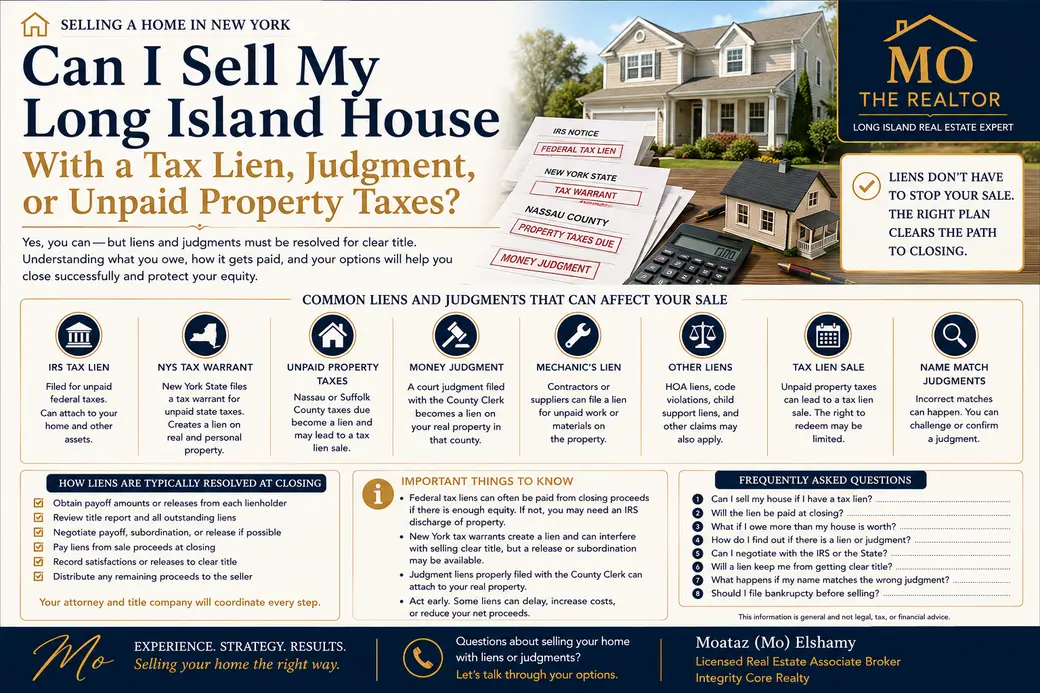
You are preparing to sell your Long Island home, but the title search reveals unpaid property taxes, an IRS lien, a New York State tax warrant, a money judgment, or another recorded claim.
Can the house still be sold? Must every lien be paid in full? Can the debt be negotiated, released, or paid directly from closing? What happens if the expected proceeds are not enough?
A lien does not automatically make the property unsellable. It does mean the seller cannot deliver clear title until the lien is paid, released, discharged, subordinated, bonded, expired, or otherwise resolved through an attorney-approved process.
Mo’s quick answer: Yes, a Long Island house can often be sold with unpaid property taxes, tax liens, or judgments. In a normal equity sale, the closing attorney and title company identify every enforceable claim, obtain written payoff or release requirements, and pay the valid liens from the sale proceeds. If the proceeds are insufficient, the seller may need a negotiated release, federal or state lien discharge, creditor settlement, short-sale approval, additional cash, or another legal solution before closing.
What Is a Lien?
A lien is a legal claim against property that helps secure payment of a debt or obligation.
Common claims that may affect a Long Island home sale include:
Property-tax lien
Unpaid county, town, school, village, or municipal property charges may attach to the property and accumulate interest or penalties.
Federal tax lien
The IRS may file a lien securing unpaid federal tax obligations against a taxpayer’s property and rights to property.
New York tax warrant
A filed State tax warrant operates like a civil judgment and creates a lien against real and personal property.
Money judgment
A judgment properly filed or docketed in the relevant county can become a lien against the debtor’s real property there.
Mechanic’s lien
A contractor, subcontractor, or supplier may claim unpaid amounts connected with labour or materials provided to the property.
Other recorded claims
Condominium liens, support liens, municipal charges, estate claims, mortgages, and home-equity lines may also affect title.
Can You Sell a House With a Federal Tax Lien?
Yes, but the federal lien must be addressed so the buyer can receive title free of that claim.
When there is enough equity, the lien is commonly paid from the seller’s proceeds at closing. The attorney or title company obtains the IRS payoff and coordinates the required release or satisfaction.
When the home is being sold for less than the amount secured by the federal lien, the taxpayer may need to apply for a discharge of the specific property from the lien. A discharge removes the lien from that property so the sale can close, but it does not necessarily erase the taxpayer’s remaining debt.
Can You Sell With a New York State Tax Warrant?
Potentially, yes.
New York State explains that a filed tax warrant creates a lien against real and personal property and may interfere with the ability to sell or transfer clear title.
The sale may require:
- Full payment through closing
- A formal payoff letter
- A release of lien
- A negotiated resolution
- A subordination or other approved arrangement
- Additional legal or tax-department documentation
Under certain circumstances, New York may consider a release or subordination when the warranted balance cannot be paid in full, but approval is not automatic.
What About a Money Judgment?
A judgment filed in the County Clerk’s Office can become a lien on the debtor’s real property in that county.
For example, a judgment filed against an owner in Nassau County may affect Nassau County property. A judgment entered elsewhere may need to be transcribed and filed in the county where the property is located before it becomes a real-property lien there.
The title company and attorney must confirm:
- Whether the judgment is against the actual owner
- Whether the name match is accurate
- Whether it was filed in the relevant county
- Whether it remains enforceable as a real-property lien
- The current balance, interest, and satisfaction requirements
- Whether a bankruptcy order, release, settlement, or other defence applies
What If the Judgment Belongs to Someone With a Similar Name?
This is common enough that it should be addressed early.
The title company may require:
- An identity affidavit
- Social Security number or date-of-birth confirmation through secure channels
- Proof of address history
- A creditor or court confirmation
- Additional underwriting review
Do not pay a stranger’s judgment merely because the name looks similar. Confirm the identity and title requirements before negotiating or paying anything.
Can Unpaid Property Taxes Be Paid at Closing?
Often, yes, when the seller has enough proceeds and the delinquency has not progressed beyond a stage that requires additional redemption or legal action.
The closing attorney or title company may obtain:
- Current tax balances
- Interest and penalties
- Tax-lien redemption figures
- Upcoming taxes and adjustments
- Municipal, water, sewer, or village charges
- Proof of payment or release requirements
In Nassau County, delinquent real-property tax liens may be included in the County’s annual tax-lien sale if they remain unpaid. Suffolk County also administers tax-lien sale and tax-deed processes, with redemption rules that depend on the property and timing.
- Do not assume the amount shown on the last tax bill is the full payoff
- Interest, penalties, subsequent taxes, and redemption charges may continue growing
- A prior tax-lien sale may require a redemption statement rather than an ordinary tax payment
- Once a tax deed or advanced enforcement process is involved, immediate legal review is essential
What Is a Tax-Lien Sale?
A tax-lien sale generally involves the government selling or retaining a lien associated with unpaid property taxes rather than immediately selling the home itself.
The owner may retain a right to redeem by paying the required amount within the applicable period. If the lien is not redeemed, the process can ultimately threaten ownership.
The seller thought the taxes could “just come out of closing”
The property had years of delinquent taxes, and a tax lien had already been sold. The seller accepted an offer without obtaining a redemption figure.
The title report later showed interest, subsequent taxes, and additional charges that were far higher than expected.
The problem was not that taxes could never be paid at closing. The problem was that no one calculated the actual redemption amount before setting the price and seller net.
Can the Seller Pay All Liens From the Closing Proceeds?
Yes, when the proceeds are sufficient and each creditor provides acceptable payoff and release instructions.
Estimated seller net = sale price
minus mortgages, taxes, liens, judgments, and redemptions
minus legal, transfer, title, and real estate professional fees
The title company or attorney may hold funds in escrow when:
- A final payoff is still being updated
- A release will be recorded after payment
- A small disputed charge requires resolution
- The parties and title insurer approve the holdback
An escrow is not available for every problem. The buyer’s lender and title insurer must agree that the closing remains insurable.
What If the Proceeds Are Not Enough?
The seller should not wait until the scheduled closing to discover the shortage.
Possible strategies include:
- Contributing cash at closing
- Negotiating a creditor settlement
- Requesting an IRS discharge of the property
- Requesting a New York State release or subordination
- Negotiating mechanic’s-lien or judgment satisfaction
- Seeking lender short-sale approval
- Resolving invalid or duplicate liens
- Obtaining bankruptcy or litigation advice
Which Liens Have Priority?
Priority can determine who is paid first when there is not enough money for everyone.
The result may depend on:
- The type of lien
- The date and place of filing
- Federal or state law
- Property-tax status
- Mortgage priority
- Subordination agreements
- Bankruptcy proceedings
- Court orders
Do not attempt to determine lien priority from the amounts alone. The title company and attorneys must analyse the recorded documents and governing law.
Can a Lien Be Negotiated?
Sometimes.
A creditor may consider:
- A discounted lump-sum payoff
- A release limited to the property
- A payment from net proceeds
- A structured settlement
- A subordination
- A bond or other security
- A satisfaction after proof of prior payment
Negotiation is strongest when the seller provides a credible contract, appraisal or market analysis, title report, estimated closing statement, payoff hierarchy, and evidence showing what funds are actually available.
What If the Lien Has Already Been Paid?
A paid debt can still appear on title if the satisfaction or release was never recorded correctly.
Gather:
- Cancelled checks or wire confirmations
- Paid-in-full letters
- Prior closing statements
- Recorded satisfactions
- Creditor correspondence
- Bankruptcy orders
- Court stipulations or dismissals
The attorney or title company may need the creditor, court, tax authority, or prior closing professional to issue or record the proper release.
Can a Mechanic’s Lien Stop the Sale?
It can prevent clear title unless it is paid, released, bonded, expired, discharged, or otherwise resolved.
The seller should determine:
- Who filed the lien
- What work or materials it relates to
- Whether the amount is disputed
- Whether the filing was timely and valid
- Whether the contractor was already paid
- Whether a bond or court application is appropriate
What If the Seller Is in Bankruptcy?
A bankruptcy filing can affect the authority to sell, the treatment of liens, creditor payments, and the use of proceeds.
The seller may need:
- Bankruptcy-court approval
- Trustee consent
- A court order addressing liens or judgments
- Coordination between bankruptcy and real estate attorneys
- Special contract language and closing conditions
Do not list or contract around an active bankruptcy without counsel confirming the seller’s authority.
How Liens Affect the Buyer
The buyer generally expects marketable title free of the seller’s debts and liens, except for items expressly accepted in the contract.
The buyer’s lender and title insurer may refuse to close until:
- Valid liens are paid or released
- Name matches are cleared
- Redemption figures are obtained
- Federal or state discharge approval is issued
- Bankruptcy or court orders are provided
- Any approved escrow is documented
Should the Seller Disclose the Liens to Buyers?
The seller should disclose the issue to the real estate attorney and listing professional immediately.
The buyer does not necessarily need private details about every debt, but anything affecting the seller’s ability to deliver title or close on time must be handled honestly and strategically.
A seller should not:
- Promise clear title without reviewing the title report
- Accept a closing deadline that cannot accommodate a discharge application
- Hide an active tax sale, bankruptcy, or foreclosure process
- Spend expected proceeds before calculating every lien
Mo’s Pre-Listing Lien Audit
- Order a title search before or immediately after listing.
- Confirm every mortgage, HELOC, tax lien, warrant, judgment, and municipal charge.
- Separate valid owner liens from name-match errors.
- Request current payoff and redemption figures.
- Determine whether proceeds are sufficient.
- Identify any federal, state, creditor, bankruptcy, or court approvals required.
- Calculate the seller’s realistic net before accepting an offer.
- Set the contract and closing timeline around the title-clearing process.
- Keep proof of all payments, settlements, releases, and filings.
- Reconfirm figures before closing because interest and charges may continue accruing.
A house with a tax lien or judgment cannot be sold.
Many liened properties are sold successfully when the claims are identified early, accurately calculated, and paid, released, discharged, negotiated, or otherwise resolved through closing.
Frequently Asked Questions
Can I sell my Long Island house with a tax lien?
Yes. The lien must be paid, released, discharged, subordinated, or otherwise resolved so the buyer can receive acceptable title.
Can unpaid property taxes be paid at closing?
Often, yes, when the sale proceeds are sufficient and the attorney or title company obtains the correct payoff or redemption amount.
Can I sell a house with an IRS lien?
Yes. If there is enough equity, the IRS lien may be paid through closing. If the proceeds are insufficient, the taxpayer may need an approved discharge of the specific property.
Can a New York State tax warrant stop a home sale?
It can block delivery of clear title until it is paid or the State approves a release, subordination, or other acceptable resolution.
Does a judgment automatically attach to every property I own?
Not necessarily. The judgment must meet New York filing and county requirements to become a lien against real property. The title company and attorney should verify its effect.
What if the judgment belongs to someone with the same name?
The title company may clear it through identity documents, affidavits, creditor confirmation, or additional underwriting rather than requiring payment.
What if the sale proceeds are not enough to pay all liens?
The seller may need cash, negotiated settlements, lien discharges, release approvals, short-sale consent, bankruptcy advice, or another legal solution.
Can the buyer close while a lien release is still pending?
Sometimes an approved escrow or title arrangement is possible, but only when the attorneys, title insurer, buyer, and lender agree that the transaction remains insurable.
Mo’s Bottom Line
A tax lien, judgment, or delinquent property-tax balance does not automatically prevent a Long Island home sale. Unverified debt and late title work do.
Order the title search, obtain current payoff and redemption figures, determine whether the proceeds are sufficient, and identify any government, creditor, bankruptcy, or court approval before accepting a closing timeline.
The goal is to convert a complicated title problem into a documented closing plan while protecting as much of the seller’s remaining equity as possible.
Selling a Long Island Home With Liens or Unpaid Taxes?
Get a confidential strategy review covering market value, title issues, payoff exposure, timing, buyer positioning, and projected seller net for coordination with your New York attorney and title company.
Request Your Home Evaluation Plan Your MoveOfficial references: Internal Revenue Service federal-tax-lien guidance; New York State Department of Taxation and Finance tax-warrant and lien-release guidance; New York State Unified Court System judgment-lien guidance; Nassau and Suffolk County delinquent-property-tax resources.
This article provides general real estate information and is not legal advice, tax advice, bankruptcy advice, title advice, debt-settlement advice, or a determination of lien validity or priority. Payoffs, releases, discharges, redemption rights, judgment liens, tax warrants, bankruptcy restrictions, title insurance, and closing requirements depend on the debt, filings, property, county, creditors, government agencies, courts, attorneys, title company, lender, and facts. Consult qualified New York real estate, tax, bankruptcy, or litigation attorneys and the appropriate title and tax professionals before taking action.
Categories
Recent Posts