

Buyer’s Mortgage Was Denied After Contract—What Can a Long Island Seller Do?
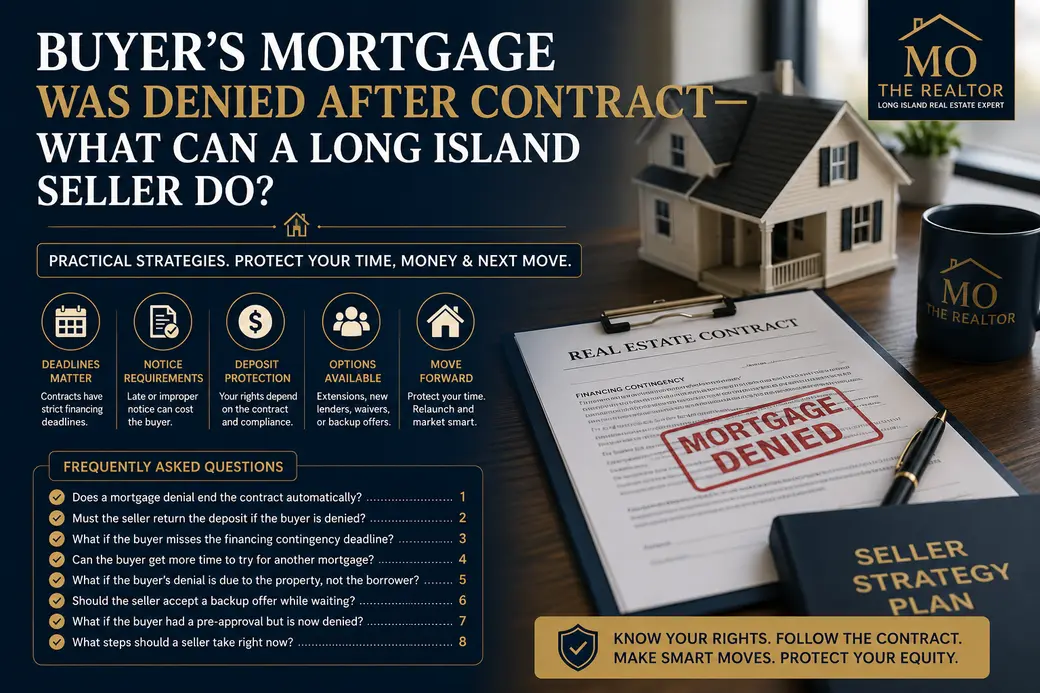
Your Long Island home is under contract. The inspection is finished. The appraisal may already be complete. The closing date is approaching—and then the buyer’s lender says the mortgage is denied.
Does the deal automatically end? Does the buyer get the contract deposit back? Can the seller keep the deposit, demand another lender, extend the deadline, or move immediately to a backup buyer?
The answer depends far less on the buyer’s explanation than on the exact mortgage-contingency language, deadlines, notice requirements, loan application, buyer conduct, and attorney correspondence.
Mo’s quick answer: A mortgage denial does not automatically determine the outcome. The buyer may be entitled to cancel and recover the deposit if the contract contains a valid mortgage contingency and the buyer complied with its conditions. But a late, unsupported, avoidable, or contractually defective denial may not protect the buyer. The seller should immediately have the attorney review the contingency, commitment deadline, application terms, denial letter, extensions, buyer cooperation, and available remedies before releasing the buyer or accepting another contract.
What Is a Mortgage Contingency?
A mortgage contingency is a contract provision that makes the buyer’s obligation to close dependent on obtaining specified financing within an agreed period and under stated terms.
The clause may identify:
- The maximum loan amount or percentage
- The loan type
- The interest-rate terms or limits
- The deadline for obtaining a commitment
- The buyer’s application deadline
- The lenders to which the buyer must apply
- The required notice if financing is denied
- Whether the seller can extend the contingency period
- Whether the buyer must accept a qualifying commitment
Why a Pre-Approved Buyer Can Still Be Denied
Income or employment changed
The buyer changed jobs, lost income, reduced hours, became self-employed, or could not document qualifying earnings.
New debt or lower credit
The buyer financed a vehicle, opened credit, missed a payment, or increased balances before closing.
Asset problem
Down-payment funds, reserves, gifts, large deposits, or transferred money could not be documented properly.
Property issue
The appraisal, condition, insurance, legal use, permits, title, occupancy, or property type did not satisfy the lender.
Loan-program problem
The property or borrower did not meet FHA, VA, conventional, jumbo, co-op, or other programme rules.
Underwriting changed the result
A pre-approval was based on preliminary information, while full underwriting uncovered a disqualifying issue.
Does the Buyer Automatically Get the Deposit Back?
No. The contract and facts control.
A buyer seeking cancellation under a mortgage contingency may need to show that the buyer:
- Applied on time
- Applied for the financing described in the contract
- Provided truthful and complete information
- Cooperated with underwriting
- Did not cause the denial through avoidable conduct
- Used diligent or good-faith efforts when required
- Delivered the required written notice before the deadline
- Provided an acceptable denial letter or supporting documentation
When the Buyer May Have a Strong Cancellation Right
- The contract contains an active mortgage contingency
- The buyer applied within the required time
- The loan request matched the contract terms
- The lender issued a genuine written denial
- The denial occurred despite the buyer’s good-faith cooperation
- The buyer gave timely and proper notice
- The buyer did not waive the contingency
- No valid commitment had already satisfied or expired the contingency
Federal consumer guidance recommends that buyers consider making purchase contracts contingent on obtaining financing because, without appropriate protection, the buyer may remain contractually obligated even if the loan is unavailable.
When the Seller Should Challenge the Cancellation
- The buyer missed the contingency deadline
- The buyer gave notice after the contingency expired
- The denial letter is vague, conditional, or incomplete
- The buyer applied for a different loan than the contract required
- The buyer failed to submit documents or respond to underwriting
- The buyer changed jobs, incurred debt, or damaged credit after contract
- The buyer refused a qualifying loan because the terms were less attractive than expected
- The buyer already received a commitment and later lost financing
- The buyer waived the mortgage contingency
- The buyer appears to be using financing as an excuse to escape the purchase
Any mortgage denial allows the buyer to cancel and receive the full deposit.
The buyer’s rights depend on the contract, deadlines, loan terms, notice, diligence, and the reason financing failed.
What If the Buyer Had a Mortgage Commitment?
A commitment does not always mean the loan is unconditional.
Mortgage commitments commonly remain subject to conditions involving:
- Final employment verification
- Updated bank statements
- Credit re-checks
- Appraisal or property conditions
- Insurance approval
- Title clearance
- Sale of another property
- Debt payoff
- No material change in the buyer’s finances
Whether a commitment satisfies the mortgage contingency—or whether a later denial revives a cancellation right—is a contract question for the attorneys.
Can the Seller Force the Buyer to Apply With Another Lender?
Sometimes the seller can request it, but the seller cannot assume the buyer is legally required to start over.
The answer depends on:
- The contract’s application and diligence language
- Whether the first denial is curable
- How much time remains
- Whether the seller agrees to extend deadlines
- Whether another lender or loan programme is realistic
- Whether the buyer still wishes to proceed
Do not grant an open-ended extension. Any extension should be written by the attorneys and should identify the new deadline, required documentation, lender status, appraisal position, closing target, and seller’s preserved rights.
Should the Seller Give the Buyer More Time?
An extension can save a strong transaction—but it can also trap the seller in a weak one.
| Reason to extend | Reason to refuse or limit |
|---|---|
| A new lender has reviewed the file and sees a clear path | The buyer has no verified replacement financing |
| The denial resulted from a correctable documentation issue | The buyer’s income, credit, or assets no longer qualify |
| The appraisal and title work can transfer or be reused | A new appraisal or lengthy approval process is required |
| The buyer remains cooperative and financially strong | The buyer has repeatedly missed deadlines |
| The seller has no stronger backup option | A qualified backup buyer is ready |
| The extension has a firm written deadline | The buyer requests indefinite additional time |
The Seller’s Five Immediate Questions
- Is the mortgage contingency still active?
- Did the buyer comply with every application and notice requirement?
- Why was the loan denied?
- Is the problem borrower-related, property-related, or lender-specific?
- Is there a credible path to closing within a defined period?
Borrower Problem or Property Problem?
Borrower-related denial
Income, employment, credit, debt, assets, reserves, documentation, or buyer conduct caused the problem.
Property-related denial
Appraisal, condition, insurance, title, legal use, permits, occupancy, flood status, co-op approval, or property eligibility caused the problem.
This distinction matters because a property-related denial may affect the next financed buyer as well.
What If the Appraisal Caused the Loan Denial?
An appraisal problem may involve:
- Value below the contract price
- Required repairs
- Unsupported legal use
- Unpermitted additions or conversions
- Property condition unacceptable to the loan programme
- Comparable-sale limitations
- Unique property characteristics
The options may include a reconsideration of value, price renegotiation, buyer shortfall coverage, another loan programme, seller repair, or cancellation—depending on the contract and financing.
What If the Buyer Waived the Mortgage Contingency?
A financing waiver can materially increase the buyer’s risk.
If the buyer agreed to purchase without a mortgage contingency, failure to obtain financing may not excuse performance. The seller may have stronger remedies, potentially involving the contract deposit or other contractual relief.
But a waiver does not answer every question. The attorneys must review:
- The exact waiver language
- Whether another contingency applies
- Whether the seller defaulted
- Whether the property could be legally conveyed
- Whether the parties later modified the agreement
- What remedies and limitations appear in the contract
Can the Seller Keep the Contract Deposit?
Possibly—but the seller should never assume the deposit can simply be taken.
The deposit is usually held in attorney escrow. If the parties dispute entitlement, the escrow agent generally cannot release it merely because one side demands it.
The outcome may depend on:
- Whether the buyer had a valid contingency right
- Whether the buyer defaulted
- Whether the seller was ready, willing, and able to close
- The contract’s default and liquidated-damages provisions
- Whether the parties sign a release
- Court or arbitration proceedings if the dispute continues
The denial that arrived after the deadline
A buyer receives a mortgage-contingency period but does not cancel by the deadline. The seller continues preparing for closing. Weeks later, the buyer provides a denial letter and asks for the full deposit back.
The issue is no longer simply whether the mortgage was denied. It is whether the buyer preserved the contractual right to cancel.
Can the Seller Accept a Backup Offer Immediately?
Not until the attorney confirms the first contract has been validly terminated or the seller can legally proceed under the contract terms.
The seller may be able to:
- Continue marketing when permitted
- Collect backup interest
- Negotiate a formal backup contract
- Set deadlines for the current buyer
- Prepare to relaunch immediately after termination
But signing a conflicting contract before the first deal is properly resolved can create serious legal exposure.
How Sellers Reduce Mortgage-Denial Risk Before Accepting an Offer
- Review the full pre-approval, not only the stated amount.
- Confirm down payment, loan type, lender, and available funds.
- Ask whether income, assets, and credit were fully reviewed.
- Understand whether the pre-approval involved underwriting or only preliminary screening.
- Compare financed offers by certainty, not price alone.
- Use meaningful contract deadlines.
- Require prompt application and documentation.
- Track appraisal, commitment, and underwriting milestones.
- Keep appropriate backup buyers engaged.
- Avoid making irreversible moving decisions before the transaction is secure.
For offer-strength analysis, read Should I Accept a Cash Offer or a Higher Financed Offer?
Mo’s Mortgage-Denial Seller Decision Matrix
| Question | Why it matters |
|---|---|
| Is the contingency active? | An expired or waived contingency may change the buyer’s cancellation rights. |
| Was notice timely and proper? | A valid reason may still fail if contract procedures were not followed. |
| Did the buyer cause the denial? | Avoidable buyer conduct may weaken the contingency claim. |
| Is the issue curable? | A short extension may preserve the transaction. |
| Is the issue tied to the property? | The next financed buyer may face the same obstacle. |
| Is another lender credible? | A verified path matters more than a vague promise. |
| How strong is the backup position? | Seller leverage depends on real alternatives. |
| What is the cost of delay? | Mortgage, taxes, insurance, moving plans, and market timing affect the decision. |
Frequently Asked Questions
What happens if a buyer’s mortgage is denied after contract in New York?
The outcome depends on the mortgage contingency, deadlines, notice, buyer compliance, reason for denial, and attorney review. The deal may be extended, restructured, cancelled, or disputed.
Does the buyer automatically get the contract deposit back?
No. The buyer generally must qualify for cancellation under the contract and comply with the contingency’s application, diligence, documentation, and notice requirements.
Can the seller force the buyer to use another lender?
Not automatically. The contract may require diligent financing efforts, but whether another application is required depends on the language and circumstances.
Should the seller extend the mortgage-contingency deadline?
Only when there is a credible and documented path to approval, a firm new deadline, and the extension is strategically better than returning to market.
Can a buyer cancel after receiving a mortgage commitment?
Possibly, but not necessarily. The attorneys must determine whether the commitment satisfied the contingency and whether later financing failure creates a valid cancellation right.
What if the buyer waived the mortgage contingency?
The buyer may remain obligated to close despite financing failure, subject to the exact waiver, other contingencies, seller performance, and contract remedies.
Can the seller keep the deposit if the loan is denied?
Possibly if the buyer defaulted and lacked a valid cancellation right. The escrowed deposit should not be released without attorney direction, agreement, or legal determination.
Can the seller move to a backup buyer after the denial?
Yes, once the attorney confirms the first contract has been properly terminated or the seller is otherwise legally free to proceed.
Mo’s Bottom Line
A mortgage denial is serious, but it is not a complete legal conclusion.
The seller must determine whether the buyer had an active contingency, followed the required process, acted in good faith, and delivered valid notice. Then the seller can decide whether to approve a tightly controlled extension, negotiate a solution, challenge the cancellation, or move to a backup buyer.
The strongest protection starts before contract: carefully compare financing strength, use clear deadlines, monitor the mortgage process, and preserve real backup interest until the transaction is secure.
Did Your Buyer’s Mortgage Get Denied?
Get a strategic review of the transaction timeline, buyer financing, property risk, backup position, relaunch strategy, and projected seller net for coordination with your New York real estate attorney.
Request Your Home Evaluation Plan Your MoveOfficial references: Consumer Financial Protection Bureau home-financing guidance and published New York court decisions involving mortgage-contingency provisions.
This article provides general real estate information and is not legal advice, lending advice, contract interpretation, or a determination of deposit rights. Mortgage contingencies, cancellation rights, deadlines, notices, commitments, defaults, escrowed deposits, and seller remedies depend on the contract, riders, attorney correspondence, lender documentation, buyer conduct, seller conduct, and facts. Consult your New York real estate attorney and qualified mortgage professionals before taking action.
Categories
Recent Posts