
Can I Sell My Long Island House If I’m Behind on Mortgage Payments?

You have fallen behind on the mortgage, but the home may still have equity. The lender is calling, late fees are growing, and perhaps a 90-day pre-foreclosure notice or foreclosure papers have already arrived.
Can you still sell the property? Will the lender stop the sale? What happens to the missed payments, legal fees, liens, taxes, and remaining proceeds?
In many cases, selling before foreclosure is completed can preserve more equity and give the homeowner greater control—but timing, payoff figures, title, court filings, and closing deadlines must be handled immediately.
Mo’s quick answer: Yes, a New York homeowner can often sell while behind on mortgage payments and even after a foreclosure action has started, provided the sale can close before the foreclosure auction and all liens and required charges can be paid or otherwise resolved. First determine the property’s realistic value, obtain a current payoff and title search, identify the foreclosure stage, and calculate whether the transaction is a normal equity sale or requires lender approval as a short sale.
Being Behind Does Not Mean You Have Already Lost the House
Missing payments creates a default, but ownership does not automatically transfer to the lender. New York uses a judicial foreclosure process. The lender must bring a court case and obtain a judgment before the property is sold at auction.
For many residential mortgages, New York requires the lender or servicer to mail a 90-day pre-foreclosure notice before starting the foreclosure lawsuit.
Can You Sell Before the Foreclosure Case Starts?
Yes. This is often the cleanest opportunity to sell. The closing proceeds can typically pay:
- The unpaid mortgage principal
- Missed payments and accrued interest
- Late charges and permitted servicing fees
- Property taxes and municipal charges
- Other mortgages, judgments, and liens
- Attorney, title, transfer, and sale expenses
Any remaining net proceeds belong to the seller, subject to ownership claims, liens, court orders, or other legal obligations.
Can You Sell After Foreclosure Papers Are Filed?
Often, yes, as long as the auction has not transferred the property and the transaction can be completed legally.
Once a foreclosure action is filed, the sale becomes more time-sensitive. The seller may need to coordinate with the mortgage servicer, foreclosure attorney, real estate attorney, title company, other lienholders, and the court-appointed referee when applicable.
How Do You Know Whether the House Has Enough Equity?
Estimated seller equity = realistic sale price
minus mortgage payoff and liens
minus taxes, legal fees, transfer costs, and real estate professional fees
Do not rely only on the principal balance shown on an old statement. A foreclosure payoff may also include accrued interest, late charges, escrow advances, legal fees, court costs, force-placed insurance, and recoverable servicing expenses.
Normal Sale or Short Sale?
Equity sale
The expected proceeds are sufficient to pay the mortgage, liens, taxes, and closing expenses in full.
Short sale
The expected proceeds are insufficient, so one or more lenders must agree to accept less than the full amount owed.
A short sale requires lender approval and may involve financial documentation, valuation review, deficiency issues, tax consequences, and longer timelines.
What If the House Is Worth More Than You Owe?
- Pay off the defaulted mortgage
- Avoid a completed foreclosure sale
- Preserve remaining equity
- Control the move-out timeline more effectively
- Reduce additional legal fees and carrying costs
Federal consumer guidance states that selling a home with equity is typically financially preferable to allowing foreclosure, completing a short sale, or transferring the property through a deed in lieu.
What If There Is Not Enough Equity?
The homeowner may need to consider a short sale, loan modification, forbearance, repayment plan, deed in lieu, bankruptcy advice, or another loss-mitigation option. These alternatives have different legal, credit, tax, timing, and occupancy consequences.
Can the Lender Refuse to Let You Sell?
In a normal equity sale, the lender is paid through the closing payoff. In a short sale, lender approval is essential because the lender is being asked to release its lien for less than the full debt.
Can a Pending Contract Stop a Foreclosure Auction?
Not automatically. A scheduled auction may require written cooperation from the lender or foreclosure attorney, a referee’s adjournment, court relief, full reinstatement, payoff, or another legally effective step.
The contract that came too late
A homeowner accepts an offer shortly before a scheduled auction and assumes the contract will stop the foreclosure. The buyer still needs financing, appraisal, title clearance, and attorney review, but no written auction adjournment is obtained.
The problem is not the offer price. The legal foreclosure clock is moving faster than the transaction.
What Documents Should the Seller Gather Immediately?
- Recent mortgage statements
- Default and acceleration letters
- The 90-day pre-foreclosure notice
- Summons, complaint, and court papers
- Modification or forbearance correspondence
- Tax and municipal-charge information
- Judgment and lien information
- Any scheduled auction notice
- Current payoff or reinstatement figures
Can You Sell While Applying for a Loan Modification?
Potentially, yes, but the strategies may conflict. A modification is intended to keep the property, while a sale transfers it. Confirm whether foreclosure activity is paused, whether the modification remains realistic and affordable, and whether the sale affects the pending application.
What If There Are Other Liens?
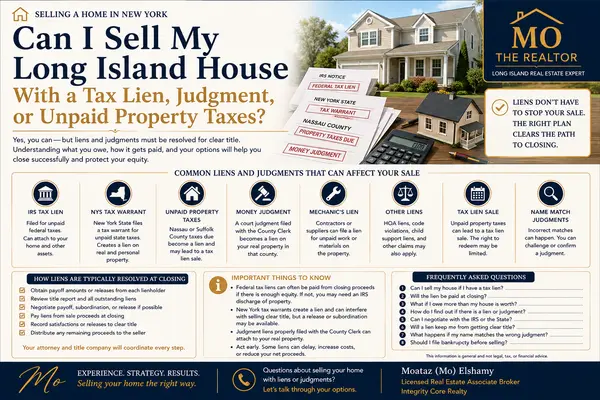
A title search may reveal a second mortgage, home-equity line, tax lien, judgment, municipal charge, common-charge lien, child-support claim, or bankruptcy restriction. Each issue must be paid, released, negotiated, bonded, or otherwise resolved before the seller can deliver marketable title.
How to Avoid Foreclosure Rescue Scams
- Do not pay large upfront fees for guaranteed foreclosure relief
- Do not sign over the deed without independent legal advice
- Do not send mortgage payments to an unknown third party
- Do not believe anyone who guarantees the lender will stop the foreclosure
- Do not sign blank or unexplained documents
Mo’s Pre-Foreclosure Sale Audit
- Confirm the foreclosure stage and every legal deadline.
- Order a realistic market-value analysis.
- Obtain current payoff and reinstatement figures.
- Order a title search for all liens and judgments.
- Calculate the estimated net after every cost.
- Determine whether the transaction is an equity sale or short sale.
- Coordinate with the foreclosure and real estate attorneys.
- Set pricing and offer deadlines around the legal timeline.
- Verify the buyer’s financing and closing ability carefully.
- Obtain written confirmation before relying on an auction adjournment.
Once the bank starts foreclosure, the homeowner can no longer sell the property.
A sale may still be possible before the auction is completed, but the foreclosure timeline, payoff, liens, title, and closing must be coordinated immediately.
Frequently Asked Questions
Can I sell my New York house if I am behind on mortgage payments?
Yes, if the sale can satisfy or otherwise resolve the mortgage, liens, taxes, and closing costs and can close before ownership is lost through foreclosure.
Can I sell after the foreclosure case has started?
Often, yes. The attorneys must coordinate the payoff, foreclosure filings, title, deadlines, and any scheduled auction.
Does listing the house stop foreclosure?
No. A listing or accepted offer does not automatically pause the court case or auction. Written lender, attorney, referee, or court action may be required.
What happens to missed mortgage payments when the house sells?
They are included in the lender’s payoff along with principal, interest, late charges, escrow advances, legal fees, and other permitted amounts.
What if the house is worth less than the mortgage payoff?
The seller may need lender approval for a short sale or may need to contribute funds, negotiate liens, or consider another foreclosure-avoidance option.
Will I receive any money after the sale?
Possibly. The seller receives the remaining proceeds after mortgages, liens, taxes, professional fees, and closing expenses are paid.
Can a pending contract stop a scheduled auction?
Not automatically. The seller needs immediate legal coordination and written confirmation of any adjournment or court relief.
Is selling better than foreclosure?
When the property has equity and there is enough time to close, selling may preserve more money, control, and flexibility than allowing a completed foreclosure.
Mo’s Bottom Line
Falling behind on the mortgage does not automatically eliminate the ability to sell. Waiting can.
Determine the legal stage, value, payoff, liens, and realistic closing timeline immediately. If equity exists, a properly managed sale may protect it. If the debt exceeds the value, the homeowner may need a short sale or another loss-mitigation strategy.
Behind on Your Mortgage but Still Have Equity?
Get a confidential strategy review covering value, payoff exposure, liens, timing, buyer positioning, sale options, and projected net proceeds for coordination with your New York attorney.
Request Your Home Evaluation Plan Your MoveOfficial references: New York State Unified Court System foreclosure guidance; New York State Department of Financial Services Foreclosure Bill of Rights and pre-foreclosure information; Consumer Financial Protection Bureau foreclosure-avoidance guidance.
This article provides general real estate information and is not legal advice, foreclosure advice, bankruptcy advice, tax advice, credit advice, lending advice, or a guarantee that a foreclosure can be stopped. Rights, deadlines, payoff amounts, reinstatement, short-sale approval, liens, auction dates, deficiency exposure, taxes, and closing ability depend on the mortgage, court case, servicer, attorneys, title, lender, property, and facts. Contact a qualified New York foreclosure attorney, your mortgage servicer, a HUD-approved housing counsellor, and other appropriate professionals immediately.
Categories
Recent Posts