
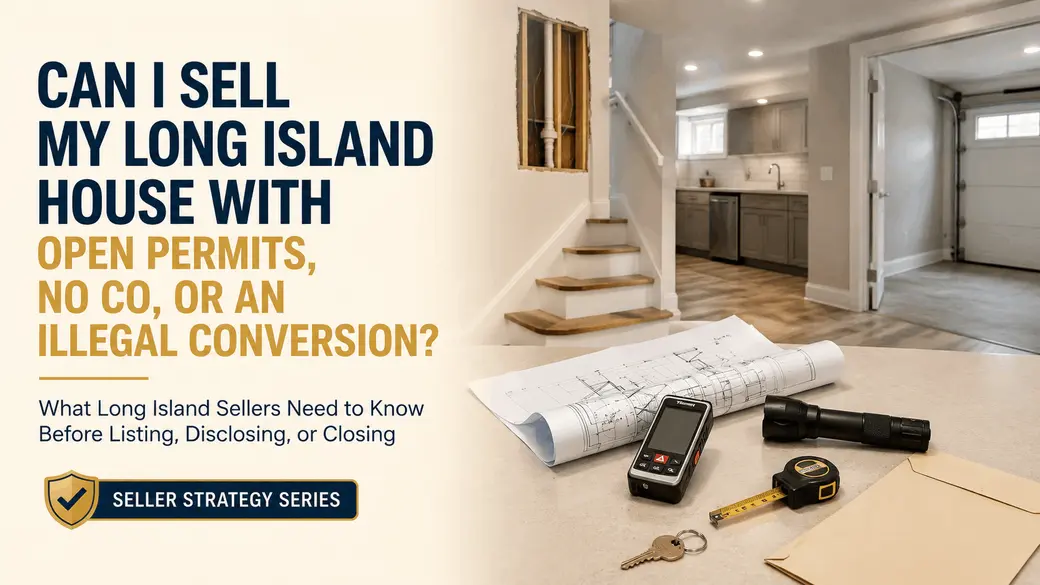
Can I Sell My Long Island House With Open Permits, No CO, or an Illegal Conversion?
You are ready to sell your Long Island home—and then the building records reveal an open permit, a finished basement with no approval, a converted garage, a second kitchen, or an addition that does not appear on the certificate of occupancy.
This is not a minor paperwork issue. It can affect the buyer pool, mortgage approval, attorney review, negotiations, closing time, and the amount you ultimately keep.
The good news is that many of these properties can still be sold. The key is identifying the issue before the buyer, lender, or attorney discovers it late in the transaction.
Mo's quick answer: You may be able to sell a Long Island house with open permits, a missing certificate of occupancy, or an unapproved conversion, but the strategy depends on the municipality, the exact work, the buyer's financing, the contract, and whether the condition can be legalised, removed, disclosed, or accepted as-is. Start with a municipal record search, current survey review, attorney consultation, and realistic value analysis before listing.
Can You Sell a Long Island House With Open Permits or No CO?
Potentially, yes. The existence of an open permit or missing approval does not automatically make a sale impossible.
But it can create serious practical obstacles:
- The buyer's attorney may require clarification or resolution
- The lender may question the legal use, condition, or collateral
- The appraisal may not credit unapproved living space
- The buyer may demand a price reduction or credit
- Insurance may become more complicated
- The closing may be delayed while records, inspections, or permits are addressed
- The buyer may cancel when the contract permits
- Cash buyers may use the issue to negotiate aggressively
Why This Is a Real Long Island Seller Problem
Long Island housing contains decades of additions, basement finishes, garage conversions, decks, dormers, second kitchens, pools, sheds, solar installations, oil-tank work, and family-use arrangements.
Different towns, cities, and incorporated villages maintain their own building records, permit processes, inspection requirements, zoning rules, and certificate procedures.
New York's current Property Condition Disclosure Statement specifically asks whether certificates of occupancy relate to the property. A seller answers based on actual knowledge, and the form advises buyers to investigate public records.
Open Permit, Missing CO, and Illegal Conversion Are Different Problems
Open permit
A permit may have been issued, but the work was never inspected, completed, signed off, or formally closed.
Missing approval
The structure or use exists, but the expected certificate, completion document, letter, or municipal record cannot be located.
Unapproved conversion
Work or occupancy changed without required permits, zoning approval, inspections, or final certification.
The solution—and the risk—depends on which problem exists. Closing an old permit may be far easier than legalising a basement apartment or reversing a garage conversion.
The Most Common Long Island Red Flags
- Finished basement without approval
- Basement bedroom or bathroom not shown in records
- Second kitchen in a one-family home
- Mother-daughter or immediate-family use without required approval
- Garage converted into living space
- Dormer, extension, enclosed porch, or addition missing from the CO
- Deck, pool, shed, fence, retaining wall, or cellar entrance without permits
- Extra apartment or rental use inconsistent with the legal occupancy
- Solar panels, generator, oil tank, HVAC, plumbing, or electrical work with incomplete records
- Old permits that were issued but never closed
- Survey showing structures that do not match municipal records
The Second Kitchen Problem
A second kitchen can raise immediate questions about whether a one-family home is being used as a two-family property or an unauthorised apartment.
In the Town of Hempstead, for example, an immediate-family or “mother-daughter” use requires Board of Appeals approval and detailed filings, including building plans and a method for returning the home to one dwelling unit after the approved family use ends.
A second kitchen is not automatically illegal everywhere, but it should never be marketed as a legal apartment or legal second dwelling without confirming the actual municipal approval and permitted use.
Important distinction: A rental registration, utility arrangement, old tax record, or long history of occupancy does not necessarily legalise the structure or use. The Town of Hempstead expressly states that its rental-registration process does not itself legalise an occupancy or establish that a structure is legally habitable.
What Sellers Should Do Before Listing
- Identify the correct jurisdiction. Determine whether the property is regulated by a town, city, incorporated village, or more than one municipal authority.
- Order a building-record search. Obtain available permits, certificates, applications, violations, approvals, and property records.
- Review the current survey. Compare structures and improvements with municipal records.
- Walk the property against the records. Identify additions, bathrooms, kitchens, bedrooms, decks, pools, sheds, conversions, entrances, and systems that may not match.
- Consult the seller's attorney early. Review disclosure, contract, title, closing, and municipal risk before marketing representations are made.
- Obtain professional estimates. If legalisation or removal may be necessary, consult the appropriate architect, engineer, expeditor, contractor, or municipal professional.
- Build multiple sale scenarios. Compare legalising before sale, selling as-is, reverting the work, or targeting a different buyer pool.
The problem sellers discover too late
A seller accepts a strong financed offer. The inspection goes well. The buyer spends money on the appraisal and attorney.
Then the survey and municipal search show that the rear extension, finished basement, and second kitchen do not match the approved records.
The lender pauses. The buyer asks for a major credit. The attorneys debate whether the seller must resolve the issue. The closing date becomes uncertain.
The same problem could have been identified and strategically priced before the listing launched.
Your Four Main Selling Strategies
Legalise before listing
Pursue permits, plans, zoning relief, inspections, and final certificates before exposing the property to buyers.
Revert or remove the work
Remove a second kitchen, restore a garage, open walls, correct unsafe work, or return the property to the approved use when practical.
Sell as-is with disclosure
Market the property with clear factual disclosure, realistic pricing, and contract terms addressing what the seller will and will not resolve.
Resolve during the transaction
Proceed while permits, inspections, escrow arrangements, removals, or municipal work are handled—only when the buyer, lender, attorneys, municipality, and timeline permit.
Should You Legalise Before Selling?
Legalising before the sale may expand the buyer pool, improve financing options, reduce negotiation pressure, and create a cleaner closing.
But it may also require:
- Architectural drawings
- Updated surveys
- Permit fees and penalties
- Zoning or Board of Appeals approval
- Opening finished walls or ceilings
- Electrical, plumbing, structural, or fire-safety corrections
- Removal of work that cannot be approved
- Multiple inspections
- Months of processing time
The investment makes the most sense when the work is likely to be approved, the cost is justified by a stronger net, and the seller's timeline allows it.
When Selling As-Is May Be the Better Strategy
An as-is sale may be more practical when:
- The seller cannot wait for municipal processing
- The cost of legalisation is uncertain or disproportionate
- The work may need substantial reconstruction
- The property already needs major renovation
- The seller is handling an estate, relocation, divorce, financial pressure, or inherited property
- A qualified buyer is willing to accept the known risk
- The price properly reflects the condition and reduced buyer pool
How These Issues Affect Financing
The effect depends on the lender, loan programme, appraiser, property use, safety, marketability, and exact documentation issue.
| Issue | Possible financing concern | Seller planning response |
|---|---|---|
| Finished basement without approval | Space may not receive full value; lender may question safety or legal use | Do not market it as approved living area without verification |
| Garage conversion | Legal use, parking, egress, heating, electrical, and marketability concerns | Confirm records and estimate legalisation or restoration |
| Second kitchen or apartment | One-family versus two-family use, rental legality, appraisal, and programme concerns | Verify legal occupancy and avoid unsupported rental-income claims |
| Open structural permit | Unfinished or uninspected work may delay approval | Determine what inspections and documents remain |
| Missing CO for addition | Collateral may not match legal records or survey | Evaluate legalisation, removal, pricing, and buyer type before listing |
Can a Cash Buyer Solve the Problem?
A cash buyer can remove mortgage-underwriting risk, but not every other issue.
The buyer's attorney may still object. The title or municipal search may reveal violations. The buyer may demand a large discount. Future resale, insurance, financing, and legal-use concerns remain.
Cash may make the transaction possible—but it does not make the work legal.
For a complete offer comparison, read Should I Accept a Cash Offer or a Higher Financed Offer?
Can the Seller Give a Credit Instead?
Sometimes the parties negotiate a price adjustment or seller credit. That does not automatically satisfy the municipality or lender.
Before agreeing, confirm:
- Whether the lender permits the credit
- Whether the buyer can legally assume the work
- Whether the municipality allows transfer with the issue unresolved
- Whether an escrow or holdback is permitted
- Who controls the permits and inspections after closing
- Whether the credit reflects realistic cost and risk
- How the contract protects both parties
A credit is a financial solution, not necessarily a legal or municipal solution. The attorneys, lender, and municipality must determine whether the transaction can close with the issue unresolved.
How Much Can a Missing CO Reduce Your Sale Price?
There is no standard discount.
The effect depends on:
- The type and size of the unapproved work
- Whether the work appears safe and professionally completed
- The likelihood and cost of legalisation
- Whether zoning relief is required
- Whether removal is practical
- The buyer's financing
- The strength of the local market
- The seller's timing pressure
- The number of qualified buyers willing to accept the issue
True impact = correction cost
plus delay and uncertainty
plus reduced buyer competition
plus the risk premium demanded by the buyer
A $10,000 correction can produce a price impact greater than $10,000 when buyers fear an unknown approval process. Clear estimates and records can reduce that uncertainty.
What Not to Say in the Listing
- “Legal two-family” without verified approval
- “Legal apartment” based only on current occupancy
- “Mother-daughter” without confirming the municipal authorisation
- “All permits in place” without checking records
- “Finished basement living space” when legal status is unknown
- “Rental income” from a use that may not be permitted
- “CO in process” when no complete application has been filed
Use precise factual wording based on verified records and attorney guidance.
Mo's Pre-Listing Permit Audit
- Identify the town, city, and incorporated-village jurisdiction.
- Order the complete municipal building-record search.
- Obtain and review the most current survey.
- Compare every visible improvement with the records.
- Confirm the legal dwelling-unit count and approved use.
- Review open permits, violations, applications, and certificates.
- Get legalisation and removal estimates where needed.
- Calculate the likely seller net under multiple strategies.
- Choose the target buyer and financing profile.
- Prepare accurate disclosure and contract language with the attorney.
The cheapest solution may be early clarity
A seller may spend months and thousands of dollars trying to legalise work that a properly informed buyer would have accepted at a reasonable price.
Another seller may rush into an as-is sale and sacrifice far more than the actual correction would have cost.
The correct strategy comes from knowing the records, the approval path, the cost, the buyer pool, and the net—not from automatically legalising or automatically discounting.
Questions to Ask Before Choosing a Strategy
- What exactly is missing or still open?
- Which municipality has jurisdiction?
- Can the work be approved as built?
- Will zoning relief be required?
- What must be opened, corrected, or removed?
- What is the realistic cost and timeline?
- How will the issue affect conventional, FHA, VA, or other financing?
- What buyer pool remains if the property is sold as-is?
- How much value could legalisation preserve?
- What contract and disclosure protections are needed?
You cannot sell a Long Island home until every permit and certificate issue is corrected.
Some properties can be sold with unresolved issues, but the buyer, financing, municipality, attorneys, disclosures, contract terms, pricing, and closing requirements determine whether the strategy is workable.
Frequently Asked Questions
Can I sell my Long Island house with an open permit?
Possibly. The permit status, remaining inspections, work condition, buyer, lender, attorneys, municipality, and contract determine whether it must be closed before the transaction can proceed.
Can I sell a house without a certificate of occupancy?
Sometimes, but first determine whether the original home lacks a record, a specific improvement lacks approval, or the current use does not match the legal occupancy. Each situation creates different risks and solutions.
Can I sell a house with an illegal basement apartment?
A sale may be possible, but the use should not be marketed as legal without verification. The seller may need to disclose the issue, remove or legalise the use, target an appropriate buyer, or negotiate contract terms addressing the risk.
Does a cash buyer care about open permits or missing COs?
Often yes. Cash removes mortgage risk but does not eliminate attorney, title, municipal, insurance, safety, resale, or legal-use concerns.
Can the buyer take responsibility for an open permit?
Sometimes, if the municipality, lender, attorneys, and contract allow it. The parties should not assume responsibility can be transferred without written approval and clear terms.
Can I give the buyer a credit for a missing CO?
A credit may help financially, but it does not automatically resolve municipal or lender requirements. The attorneys and lender must determine whether the transaction can close with the issue outstanding.
How do I find open permits on a Long Island property?
Identify the correct town, city, and incorporated village, then request building records through the applicable municipal department or permit portal. A current survey and attorney review are also important.
Should I legalise unpermitted work before selling?
Legalisation may expand the buyer pool and protect value, but the decision should be based on approval probability, cost, timing, required corrections, expected sale price, and the seller's net under each strategy.
Mo's Bottom Line
Open permits, missing COs, and unapproved conversions are real Long Island transaction problems—but they are not all the same problem.
Do not wait until the buyer's attorney or lender discovers the issue. Order the records, compare them with the survey and property, speak with the attorney, estimate the correction path, and decide whether to legalise, remove, disclose, or sell as-is.
The right strategy is the one that protects the strongest realistic net while giving the buyer, lender, attorneys, and municipality a workable path to closing.
Do You Have an Open Permit, Missing CO, or Unapproved Conversion?
Get a confidential pre-listing strategy for the property's records, market value, likely buyer pool, correction options, and projected seller net before the issue controls your sale.
Request Your Home Evaluation Plan Your MoveOfficial references: New York State Department of State, Property Condition Disclosure Statement effective July 1, 2025; Town of Hempstead Building Department and Online Permit Center; Town of Hempstead Mother-Daughter Use and Rental Property Registration guidance; Town of North Hempstead Department of Building, Safety, Inspection and Enforcement; Town of Oyster Bay Building Division.
This article provides general real estate information for Long Island homeowners and is not legal advice, zoning advice, architectural or engineering advice, municipal approval, title advice, lending advice, an appraisal, or a guarantee that a property can close with an unresolved permit or certificate issue. Requirements vary by town, city, incorporated village, property, work performed, legal use, lender, insurer, buyer, attorney, survey, contract, and municipal record. Consult the applicable building department, your attorney, lender, architect, engineer, expeditor, and other qualified professionals before making decisions.
Categories
Recent Posts