Can I Sell My Long Island House With Solar Panels Still Financed or Leased?
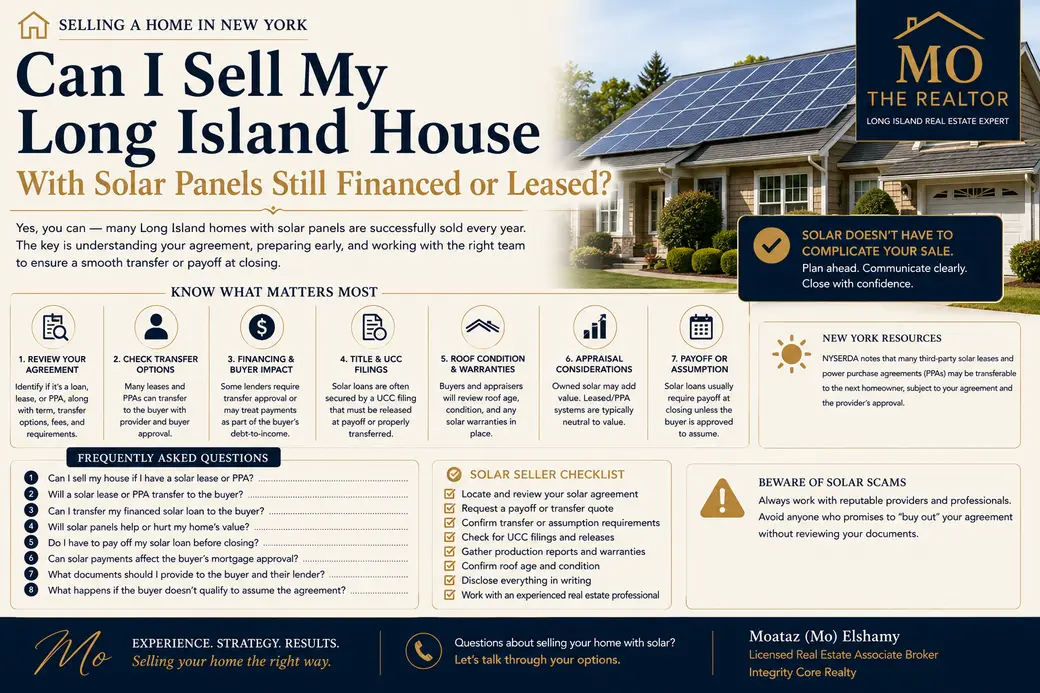
You are preparing to sell your Long Island home, but the solar panels are still under a lease, power purchase agreement, or loan.
Will the buyer have to take over the payments? Can the solar company delay closing? Does the loan have to be paid off? What if the buyer loves the house but does not qualify to assume the solar obligation?
Solar can be a valuable feature, but the ownership and financing structure—not simply the panels—determines whether it helps the sale or becomes a contract problem.
Mo’s quick answer: Yes, a Long Island home can usually be sold with solar panels, but the seller must identify whether the system is owned outright, financed, leased, or subject to a power purchase agreement. Obtain the complete contract, current payoff or transfer instructions, lien or filing information, utility records, warranty documents, and roof details before listing. Then determine whether the buyer must assume the agreement, the seller must pay it off, or another approved transfer structure is available.
The Four Solar Arrangements Sellers Must Distinguish
Owned outright
The seller owns the equipment with no remaining solar loan, lease, or PPA obligation.
Solar loan
The homeowner owns the equipment but still owes money to a solar lender or financing programme.
Solar lease
A third party owns the system, and the homeowner pays a scheduled lease amount for its use.
Power purchase agreement
A third party owns the system, and the homeowner pays for the electricity it produces under the contract.
Can You Sell a House With Owned Solar Panels?
Usually, this is the simplest scenario.
The seller should still gather:
- Proof the system is fully paid
- Installation and permit records
- Warranty information
- Recent electric bills and production records
- Roof age and condition
- Any transferable service agreement
- Documentation showing that financing filings were released
Owned panels may make the home more attractive, but the seller should not promise a specific increase in value or guaranteed savings without supporting records.
What Happens If There Is a Solar Loan?
Solar-loan treatment depends on the lender and financing documents.
The Consumer Financial Protection Bureau explains that when a homeowner sells before a solar loan is paid off, common options may include the buyer assuming the loan when the lender permits it or the seller paying off the remaining balance before or at closing.
Some financing programmes may permit transfer to the new owner, while others leave the original borrower responsible even after the property is sold.
What Happens With a Solar Lease or PPA?
NYSERDA’s homeowner guidance explains that a third-party-owned lease or PPA can often be transferred to the next homeowner for the remainder of the contract term, but the exact contract controls.
The buyer may need to:
- Review the complete agreement
- Submit a transfer application
- Meet the solar company’s credit requirements
- Accept the remaining term and payment structure
- Sign transfer or assumption documents
- Wait for formal solar-company approval
If the buyer refuses or fails to qualify, the seller may need to negotiate another solution, which could include prepayment, buyout, or selecting a different buyer.
What Documents Should Be Collected Before Listing?
- The original purchase, loan, lease, or PPA agreement
- All amendments and addenda
- Current payoff, buyout, or prepayment quote
- Transfer requirements and processing time
- Monthly payment and escalation terms
- System size and installation date
- Production history
- Electric bills before and after installation, when available
- Warranty and maintenance documents
- Permits and final approvals
- Roof warranty and installation details
- Any UCC filing, declaration, lien, or notice affecting title
Do not wait until contract to request the solar paperwork. Transfer departments, payoff teams, and title corrections can take time.
Can Solar Financing Affect the Buyer’s Mortgage?
Potentially, yes.
The buyer’s lender may evaluate:
- Whether the solar payment counts as a monthly debt
- Whether the agreement transfers with the property
- Whether a lien or UCC filing affects title priority
- Whether the system is owned or third-party-owned
- Whether the appraisal treats the panels as part of the real property
- Whether the buyer can qualify with the added obligation
The buyer should provide the solar documents to the mortgage professional early—not after underwriting discovers the obligation.
What Is a UCC Filing, and Why Does It Matter?
Some solar companies or lenders file a Uniform Commercial Code financing statement or other recorded notice relating to the equipment or financing obligation.
Even when the filing is not a conventional mortgage on the house, the title company and mortgage lender may require:
- Clarification of what the filing covers
- A temporary termination or subordination
- A payoff and permanent release
- Re-filing after closing
- Written consent from the solar company
The solar transfer that delayed closing
The buyer accepts the lease in principle, but the full agreement is not delivered until late in the transaction. The lender then discovers a recorded solar filing and requires additional documentation.
The solar company needs time to process the transfer and issue the title paperwork.
The problem is not that the home has solar. The problem is that the seller treated the solar contract like an electric bill instead of a closing document.
Can the Seller Pay Off the Solar Loan at Closing?
Often, yes, when the lender permits payoff through closing and the seller has enough proceeds.
The attorney and title company should obtain:
- A current written payoff
- Wire or payment instructions
- Confirmation of any prepayment charge
- Release instructions for recorded filings
- Expected timing for the satisfaction or termination
The payoff amount should be included in the seller’s net calculation before the offer is accepted.
Should the Seller Pay It Off or Ask the Buyer to Assume It?
| Strategy | Potential advantage | Main risk |
|---|---|---|
| Seller payoff | Creates a cleaner transfer and easier buyer comparison | Reduces the seller’s net proceeds |
| Buyer assumption | Preserves the seller’s cash when permitted | Buyer may reject the obligation or fail qualification |
| Contract buyout | May convert third-party ownership into owned equipment | Buyout price and timing may be substantial |
| Prepayment without buyout | May remove future payments while the provider retains ownership | Contract responsibilities may continue |
| Price adjustment | Can compensate the buyer for assuming the agreement | Does not solve lender, title, or transfer requirements |
How Solar Payments Affect the Seller’s Net
True seller net = sale price
minus mortgages, liens, solar payoff or buyout
minus taxes, legal costs, and real estate professional fees
A seller who ignores a $25,000 solar balance may believe an offer is stronger than it actually is.
Compare offers using the seller’s final net after:
- Solar payoff or transfer costs
- Buyer credits
- Roof work connected to the system
- Title and filing fees
- Repair or removal obligations
- Possible delay and carrying costs
What If the Buyer Does Not Want the Solar Agreement?
The seller may need to consider:
- Paying off the loan
- Buying out the lease or PPA
- Prepaying the remaining obligation
- Negotiating a price concession
- Finding a buyer willing and able to assume it
- Exploring removal only when the provider and contract permit it
Panel removal is not automatically practical. It may create roof, warranty, permit, electrical, and contract issues.
What If the Roof Needs Replacement?
Solar and roofing must be analysed together.
The seller should determine:
- The roof’s age and expected life
- Who may remove and reinstall the panels
- The removal and reinstallation cost
- Whether using another contractor affects warranties
- Whether the solar company requires advance scheduling
- Whether roof work must occur before closing
Do Solar Panels Increase the Home’s Appraised Value?
Sometimes, but not automatically.
The result can depend on:
- Whether the panels are owned or third-party-owned
- System age and condition
- Production and savings documentation
- Comparable sales
- Local buyer demand
- Appraisal and lender guidelines
A seller should market verified benefits without assigning an unsupported dollar value to the system.
What Should Be Disclosed to Buyers?
Provide accurate information about:
- Ownership and financing type
- Remaining term and payment
- Annual escalation, if any
- Transfer or qualification requirements
- Payoff or buyout options
- Known system defects or service issues
- Roof condition and panel installation
- Recorded filings or title requirements
Do not market the panels as “owned” when a lender, lessor, or PPA provider still has contractual rights.
Common Solar Sale Mistakes
- Calling financed panels fully owned.
- Assuming the buyer can take over the agreement.
- Failing to include the payoff in the seller’s net.
- Waiting until closing to address a UCC filing.
- Providing only a one-page bill instead of the complete contract.
- Ignoring annual payment increases.
- Failing to coordinate the roof and solar warranties.
- Promising savings that the records do not support.
The buyer automatically takes over the solar payments when the deed transfers.
The solar company, lender, contract, buyer qualification, title requirements, and closing documents determine whether and how the obligation transfers.
Mo’s Pre-Listing Solar Audit
- Identify whether the system is owned, financed, leased, or under a PPA.
- Obtain the complete signed agreement and all amendments.
- Request current payoff, buyout, prepayment, and transfer options.
- Confirm buyer qualification and processing requirements.
- Review liens, UCC filings, declarations, and title instructions.
- Gather permits, warranties, production data, and electric bills.
- Evaluate roof age and removal or reinstallation exposure.
- Confirm what must occur before closing.
- Include all solar costs in the seller’s net sheet.
- Present the obligation clearly before accepting an offer.
Frequently Asked Questions
Can I sell my Long Island house with solar panels still financed?
Yes, but the loan documents determine whether the buyer may assume the balance or the seller must pay it off before or at closing.
Can a buyer take over a solar lease or power purchase agreement?
Often, but the solar provider may require an application, credit approval, signed transfer documents, and acceptance of the remaining contract terms.
Do I have to pay off the solar panels before selling?
Not always. Some agreements permit transfer, while others require or make payoff the most practical option. Review the actual contract and written provider instructions.
Can solar financing delay a home closing?
Yes. Missing contracts, transfer approval, buyer qualification, payoff processing, or recorded solar filings can delay title and mortgage clearance.
Will the buyer’s mortgage lender count the solar payment as debt?
Potentially. Treatment depends on the ownership structure, agreement, loan programme, buyer obligations, and lender underwriting.
What happens to a UCC filing when the house sells?
The title company and buyer’s lender may require termination, subordination, payoff, consent, or other documentation from the solar company or lender.
Do owned solar panels increase home value?
They may contribute value, but the result depends on ownership, system age, production, condition, comparable sales, buyer demand, and appraisal guidelines.
What if the buyer refuses to assume the solar agreement?
The seller may need to pay off or buy out the obligation, negotiate another solution, adjust the price, or proceed with a different qualified buyer.
Mo’s Bottom Line
Solar panels do not automatically make a Long Island home harder to sell. An unclear solar obligation does.
Determine who owns the system, who owes the money, whether the agreement transfers, how title will be cleared, and what the true payoff does to the seller’s net.
The strongest sale is built before the listing goes live: complete documents, verified transfer rules, accurate marketing, and a closing plan that does not depend on assumptions.
Selling a Long Island Home With Solar Panels?
Get a strategic review of the solar agreement, payoff or transfer exposure, roof condition, buyer positioning, title risk, and projected seller net.
Request Your Home Evaluation Plan Your MoveOfficial references: NYSERDA homeowner guidance on solar leases, loans, and power purchase agreements; Consumer Financial Protection Bureau solar-financing guidance; New York State Attorney General solar consumer guidance.
This article provides general real estate information and is not legal advice, lending advice, tax advice, title advice, solar-contract advice, appraisal advice, or a guarantee of transfer approval. Solar payoff, assumption, lease or PPA transfer, buyer qualification, UCC filings, title clearance, appraisal, warranties, roof obligations, and closing requirements depend on the agreement, lender, provider, buyer, seller, attorneys, title company, mortgage lender, utility, and facts. Consult the appropriate New York attorneys, title professionals, mortgage professionals, tax advisers, solar provider, and qualified contractors before taking action.
Categories
Recent Posts