Does a New Roof Increase Your Home's Value? What Long Island Sellers Should Know
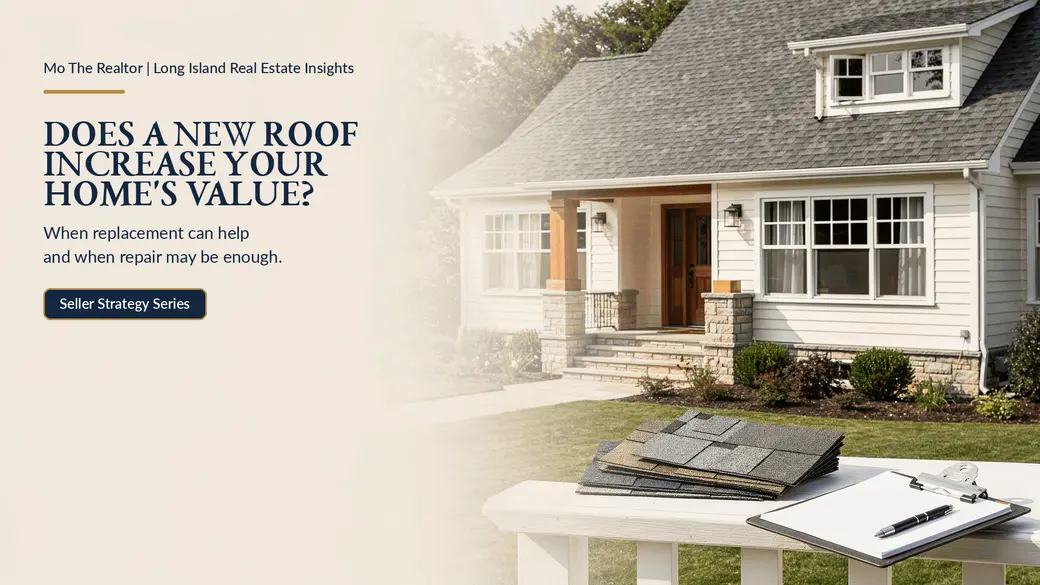
A new roof can make a home more attractive to buyers, reduce uncertainty, and remove one of the largest potential post-closing expenses.
But replacing a roof simply because the house is going on the market is not automatically the smartest financial decision.
The right strategy depends on the roof's condition, remaining useful life, repair history, visible deterioration, financing risk, insurance concerns, competition, and the home's overall market position.
Mo's quick answer: Replace the roof when it is actively failing, leaking, visibly deteriorated, repeatedly repaired without lasting success, or likely to create a serious inspection, lending, or insurance problem. Repair it when the damage is isolated and the roof still has meaningful life remaining. Leave it alone when it is older but performing properly and unlikely to weaken buyer confidence.
Does a New Roof Increase Home Value?
Generally, yes—but not dollar for dollar.
Buyers appreciate knowing that one of the home's largest exterior systems has already been addressed. That peace of mind may contribute to:
- More buyer interest
- Stronger overall confidence
- Fewer inspection objections
- A smoother negotiation
- A lower perceived risk of major near-term expense
But a seller should not assume that spending $20,000 or $25,000 on a roof automatically raises the sale price by the same amount.
Should You Replace the Roof Before Selling?
Replacement deserves serious consideration when:
- The roof is actively leaking
- Shingles are missing, curling, deteriorating, or failing
- Prior repairs have not solved the problem
- The roof is near the end of its useful life and visibly worn
- Inspection findings are likely to create a major buyer objection
- The condition may create insurance or financing complications
- The roof is materially weaker than competing homes
If the roof is in sound condition and still has useful life remaining, replacing it only because the house is being listed may not be necessary.
Replace when
The roof is failing, leaking, repeatedly patched, visibly deteriorated, or likely to become a serious transaction obstacle.
Do not replace automatically when
The roof is older but performing properly, has no active leak, presents no major concern, and the seller's money would create more value elsewhere.
Can You Sell a House With an Older Roof?
Absolutely. Homes sell every day with roofs that are not brand new.
The important question is not simply, “How old is the roof?” It is, “Does the roof still perform as intended?”
Age is only one factor. Installation quality, materials, ventilation, maintenance, weather exposure, repairs, and current condition also matter.
Condition matters more than age alone: An older, well-maintained roof may create less concern than a newer roof with poor workmanship or unresolved leaking.
Will Buyers Walk Away Because of an Old Roof?
Sometimes—especially when the roof creates uncertainty that buyers cannot comfortably price.
Concern rises when:
- There is an active leak
- Damage is visible from the ground or attic
- The inspection identifies major deterioration
- The buyer cannot obtain acceptable insurance
- The lender or loan programme requires correction
- The seller has no documentation and cannot explain prior repairs
- The likely replacement cost is substantial and immediate
Even when buyers do not walk away, the roof may become a major negotiating point.
What About FHA, VA, and Other Financed Buyers?
Property-condition concerns can become more important when a buyer is using financing.
An older roof does not automatically prevent financing. However, active leaking, significant deterioration, safety concerns, or a condition that affects habitability or insurability may create additional requirements before closing.
When a Newer Roof Strengthened Buyer Confidence
A major system had already been handled
I listed a home where the seller had replaced the roof only a few years earlier.
It was not the flashiest feature, and it was not necessarily the first thing buyers discussed.
But it gave buyers confidence. They knew one of the home's largest systems had already been addressed and was less likely to become an immediate expense after closing.
The roof supported the property's overall value even though it was not the emotional centrepiece of the sale.
When I Advised Sellers Not to Replace the Roof
Useful life remained, so we focused elsewhere
I have also advised sellers not to replace a roof that was still performing properly and had useful life remaining.
Instead, we focused on improvements buyers noticed immediately, including paint, decluttering, presentation, and other visible priorities.
The sellers avoided a major expense and still attracted strong buyer interest.
The smartest improvement was not the most expensive one.
For the wider decision, read Should I Renovate My House Before Selling or Sell It As Is?
Repair or Replace?
If the roof has isolated damage but still has good remaining life, professional repair may be the stronger investment.
If the roof is broadly failing, actively leaking, repeatedly patched, or likely to become a major issue during inspection, replacement may be the better strategic decision.
| Roof condition | Likely strategy | Reason |
|---|---|---|
| Minor isolated damage | Professional repair | The roof may still have useful life remaining |
| Small leak with identifiable source | Repair and document | A focused correction may resolve the issue |
| Repeated leaks or failed repairs | Consider replacement | Ongoing patching may not restore buyer confidence |
| Widespread curling, missing, or deteriorated shingles | Replacement likely | The condition may indicate broad failure |
| Older but dry and performing properly | Usually leave alone | Age by itself may not justify the expense |
| Condition may affect financing or insurance | Evaluate promptly | The roof may become a transaction obstacle |
The Biggest Mistake Sellers Make
Many homeowners assume that if they spend $20,000 on a roof, they will receive $20,000 more for the house.
That is rarely how the market works.
Buyers generally expect the roof to function. A new roof reduces uncertainty, protects confidence, and may improve the property's position. But it does not automatically produce an equal increase in sale price.
What Buyers and Inspectors May Notice
- Active water staining or moisture
- Missing, curling, cracked, or deteriorated shingles
- Visible sagging or uneven roof areas
- Damaged flashing around chimneys, vents, or roof transitions
- Repeated patching
- Deteriorated roof edges or trim
- Interior ceiling stains connected to unresolved leakage
- Evidence that repairs were cosmetic rather than corrective
- Lack of documentation for recent replacement or major repair
Documentation Can Strengthen the Value
If the roof was replaced or professionally repaired, useful records may include:
- Contractor invoice
- Approximate completion date
- Material or manufacturer information
- Warranty documents
- Transfer terms, if applicable
- Permit or municipal records, when required and available
- Photos of completed work
Do not assume a contractor or manufacturer warranty transfers automatically. Confirm the terms directly.
How to Decide Whether Roof Replacement Will Pay Off
- Determine whether there is an active leak, visible deterioration, or repeated repair history.
- Obtain a professional assessment of condition and likely remaining life.
- Price repair and replacement separately.
- Include removal, disposal, decking repairs, flashing, ventilation, permits where applicable, and contingency.
- Consider how the condition may affect buyers, inspection, insurance, and financing.
- Compare the home with competing listings at the expected price point.
- Evaluate whether the project will delay the listing.
- Compare the expected benefit with other repairs competing for the same money.
Use What Should I Fix Before Selling My House? to compare the roof with the property's other priorities.
Before approving a major project, also review What Home Improvements Are a Waste of Money Before Selling?
Mo's Roof Replacement Test
Before spending, ask:
- Is the roof actively failing, or is it simply older?
- Is the damage isolated or widespread?
- Have prior repairs lasted?
- Could the condition create an inspection, insurance, or financing problem?
- Will buyers care enough to change their offer?
- Would professional repair solve most of the concern?
- Would the same budget produce a stronger return elsewhere?
Every older roof should be replaced before selling.
An older roof that is dry, functional, and still performing may not need replacement. Replace or repair it because it solves a real buyer or transaction concern—not because of age alone.
Frequently Asked Questions
Does a new roof increase home value?
A new roof may improve buyer confidence, reduce objections, and strengthen marketability, but sellers should not expect to recover every dollar automatically.
Should I replace my roof before selling?
Replacement may make sense when the roof is leaking, broadly deteriorated, repeatedly repaired without success, or likely to create a major inspection, insurance, or financing problem. A roof with useful life remaining may not need replacement.
Can I sell my house with an older roof?
Yes. Homes sell with older roofs when the roof is still performing, the condition is disclosed appropriately, and the property's pricing and overall value reflect the situation.
Will buyers walk away because of an old roof?
Some may, especially when there is active leaking, visible deterioration, uncertain replacement cost, or difficulty obtaining financing or insurance. Others may proceed if the home's overall value remains compelling.
Should I repair or replace the roof before listing?
Repair is often appropriate for isolated damage when the roof still has good remaining life. Replacement is more appropriate when the roof is broadly failing, leaking repeatedly, or beyond dependable repair.
Does an old roof affect FHA or VA financing?
Age alone does not automatically prevent financing. Actual condition matters. Active leaks, significant deterioration, safety concerns, or insurability issues may create requirements in a specific transaction.
What roof records should a seller keep?
Keep invoices, installation dates, contractor information, material details, warranty documents, transfer terms, permits where applicable, and records of professional repairs.
Mo's Bottom Line
A roof should give buyers confidence—not create unanswered concerns.
Sometimes replacement is the right move. Sometimes a professional repair is enough. Sometimes the roof should remain exactly as it is because it still performs properly and the seller's money would create more value elsewhere.
The smartest renovation is not always the most expensive one. It is the one that delivers the strongest overall outcome.
Before You Replace the Roof, Compare the Real Return
I can help you determine whether the roof needs replacement, a focused repair, documentation, strategic pricing, or no pre-sale work at all.
Get a Realistic Home Value Range Plan Your MoveThis article provides general real estate information for Long Island homeowners and is not legal, engineering, environmental, lending, insurance, appraisal, inspection, roofing, warranty, or contracting advice. Costs, requirements, remaining life, performance, and transaction results vary by property, materials, installation, municipality, insurance carrier, lender, market conditions, and transaction. Consult the appropriate licensed professionals regarding your specific circumstances.
Categories
Recent Posts