

Why Your Home Isn't Selling (And It's Probably Not the Market)
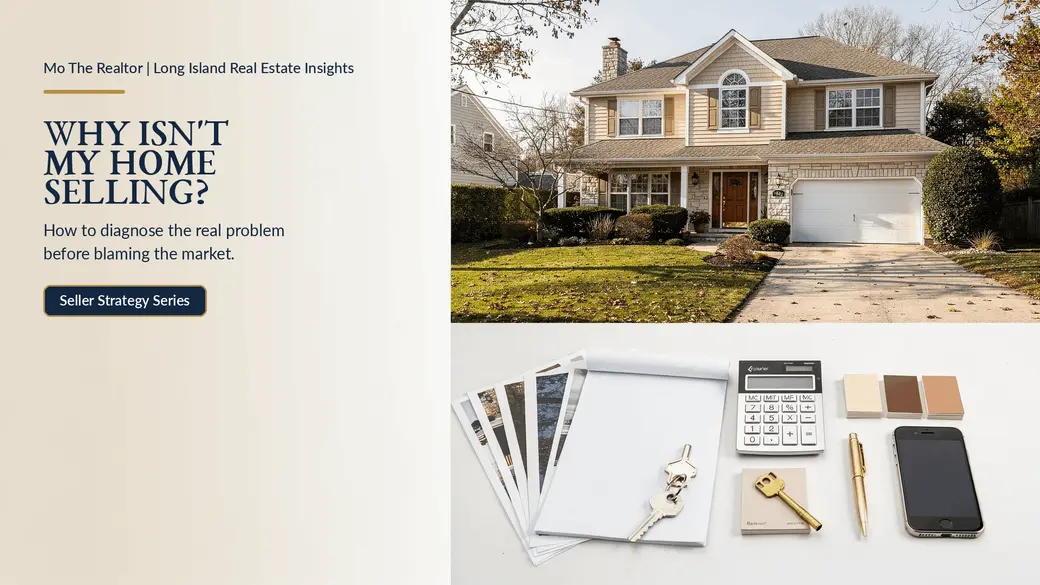
When a home sits without strong activity, sellers often assume the entire market is the problem.
Sometimes the market is slower. But most unsuccessful listings reveal a more specific issue involving price, presentation, marketing, or positioning.
The good news is that once the real problem is identified, the strategy can usually be corrected.
Mo's quick answer: If your home is not selling, diagnose the response before making random changes. Low online interest often points to price, positioning, or weak media. Strong views but few showings may signal poor presentation or an unattractive value proposition. Showings without offers usually indicate that buyers prefer the competition at the current price and condition.
Why Isn't Your Home Selling?
The market is rarely rejecting the existence of the home. It is responding to how the property compares with every other option available to the same buyer.
Price
The asking price may exceed the value buyers perceive when compared with recent sales and current alternatives.
Presentation
The home may not feel inviting, maintained, spacious, bright, or ready enough to justify the price.
Marketing
The photography, description, exposure, outreach, launch, or follow-up may not be creating enough qualified attention.
Positioning
The property may be targeting the wrong buyer, competing in the wrong price range, or presented without a clear value story.
1. The Home May Be Overpriced
Overpricing is one of the most common reasons homes sit on the market.
The strategy often begins with: “Let us start high. We can always reduce later.”
The problem is that buyers search within price ranges and compare value quickly. When a home enters the market too high:
- Some qualified buyers never see it because it falls outside their search
- Others compare it with stronger homes at the same price
- Buyers may assume the seller is unrealistic
- The most motivated prospects move on
- Later reductions may attract less excitement than the original launch
For a deeper explanation, read How Much Is My House Really Worth?
The First Few Weeks Matter
A new listing receives its strongest natural wave of attention early. Buyers who have been waiting for the right property see it, agents share it, portals feature it as new inventory, and the market begins testing the price.
If the home fails to generate meaningful activity during that period, waiting without analysing the response may cause the seller to chase the market later.
Early activity is information: views, saves, enquiries, showings, repeat visits, offers, and feedback reveal how the market is interpreting the listing.
2. The Presentation May Be Working Against You
Buyers make practical decisions, but emotion determines whether they feel excited enough to act.
A home may be structurally sound yet lose buyers because it feels dark, crowded, dated, unfinished, poorly maintained, or difficult to imagine living in.
High-impact corrections may include:
- Deep cleaning
- Decluttering and removing oversized furniture
- Fresh, neutral paint where needed
- Improved lighting and brighter bulbs
- Simple staging
- Exterior cleanup and stronger curb appeal
- Professional photography after preparation is complete
The goal is not to make the house perfect. It is to reduce distractions and help buyers understand the home's value quickly.
Use What Should I Fix Before Selling My House? to prioritise improvements instead of spending randomly.
3. The Marketing May Be Too Weak
Uploading a property to the MLS is distribution. It is not the entire marketing plan.
A strong campaign may include:
- Professional photography
- A compelling and accurate property description
- Strategic syndication and online exposure
- Social-media promotion
- Email campaigns
- Direct buyer-agent outreach
- Open houses when appropriate
- Fast responses to enquiries
- Consistent follow-up and feedback collection
4. The Home May Be Positioned Incorrectly
Positioning is the story the market understands when it sees the home.
Is it:
- A move-in-ready home competing with renovated properties?
- A dated but well-maintained home offering strong overall value?
- An as-is opportunity for a renovation-minded buyer?
- A premium property justified by location, condition, and features?
- A home priced to create urgency and competition?
When the price, condition, photographs, remarks, and buyer target tell different stories, the listing becomes confusing.
What the Listing Activity May Be Telling You
| Observed response | Possible meaning | What to review |
|---|---|---|
| Very low online views | Weak launch, poor media, limited exposure, or pricing outside buyer searches | Photography, headline, distribution, search brackets, and price |
| Many views but few enquiries | Buyers see the listing but do not perceive enough value | Price, first photo, remarks, condition, and competition |
| Enquiries but few appointments | Showing access, qualification, presentation, or property limitations may be discouraging buyers | Access, scheduling, buyer questions, disclosures, and listing clarity |
| Showings but no offers | Buyers may prefer competing homes at the same price | Feedback patterns, condition, layout, objections, and price |
| Only low offers | The market may see value, but below the current expectation | Comparable sales, competing listings, terms, and buyer pool |
| Repeat showings but no commitment | Buyers may like the home but remain concerned about price, condition, or a specific risk | Second-visit feedback, inspection concerns, disclosures, and negotiation strategy |
A Real Pricing and Positioning Lesson
The market—not promises—determines the result
I worked with a seller who believed his home was worth well over one million dollars because several agents had told him exactly what he wanted to hear.
After reviewing the actual market, I recommended a more realistic strategy.
We started higher than I preferred to respect the seller's wishes, but I explained that if qualified activity did not materialise, we would need to respond quickly.
The lesson was not about proving who was right. It was about understanding that the market—not wishful thinking—determines value.
Honest advice on day one is more valuable than an attractive promise followed by months of reductions.
Should You Lower the Price?
Maybe. But do not reduce the price simply because time has passed.
First diagnose the problem:
- Is the marketing strong enough?
- Are qualified buyers seeing the listing?
- Are online views turning into enquiries?
- Are enquiries converting into showings?
- Are showings producing second visits or offers?
- What feedback appears repeatedly?
- Is condition hurting the value proposition?
- Is the price competitive with current alternatives?
A price adjustment may be appropriate when
The marketing and presentation are strong, access is reasonable, the home has received sufficient exposure, and qualified buyers consistently prefer competing properties at the current price.
A non-price correction may be appropriate when
The photographs are weak, the home shows poorly, access is difficult, the listing lacks exposure, or an avoidable presentation issue is preventing buyers from seeing the value.
How Much Should the Price Change?
A reduction should be strategic enough to change the property's competitive position—not merely show that the seller made a small adjustment.
The right amount depends on:
- The current comparable-sales range
- Active listings buyers are choosing instead
- Important online search thresholds
- Days on market and previous reductions
- The urgency of the seller's timeline
- The home's condition and buyer objections
- Whether the new price creates a genuinely stronger value proposition
The Biggest Mistakes Sellers Make
- Pricing from emotion instead of evidence
- Assuming renovations add dollar-for-dollar value
- Accepting poor photography or weak presentation
- Restricting showing access unnecessarily
- Ignoring repeated buyer feedback
- Waiting too long to adjust the strategy
- Making tiny reductions that do not reach a new buyer pool
- Blaming the market before identifying the actual problem
If the house has not sold, the market must be bad.
The market may be slower, but the listing's price, presentation, marketing, access, and positioning still determine how well it performs against the competition.
A Step-by-Step Listing Reset
- Review the original pricing logic and current comparable sales.
- Compare the home with active and pending alternatives.
- Analyse online views, saves, enquiries, showings, repeat visits, and offers.
- Identify repeated feedback rather than reacting to one opinion.
- Inspect the presentation in person and through the listing photographs.
- Review showing access, response speed, and buyer-agent follow-up.
- Correct the highest-impact non-price issues.
- Adjust the price when the evidence shows the current position is not competitive.
- Relaunch the story consistently across photography, remarks, outreach, and social media.
Mo's Listing Diagnosis Test
Before blaming the market, ask:
- Would buyers consider this home a strong value at the current price?
- Does the listing attract attention in the first few seconds?
- Does the home look as good in person as it does online?
- Are buyers able to schedule showings easily?
- Is there enough qualified exposure?
- What objection appears most often?
- Has the strategy changed as the evidence changed?
Mo's quick take: Identify the real problem first. Then correct the right problem—not merely the easiest or most comfortable one.
Frequently Asked Questions
Why is my house not selling?
The most common causes are price, presentation, marketing, positioning, limited access, or a combination of those factors. Listing activity and buyer feedback can help identify the real issue.
Is the market the reason my home is not selling?
A slower market can affect every listing, but individual properties still compete on value, condition, exposure, access, and presentation. Compare your results with similar homes before blaming the entire market.
How do I know whether my home is overpriced?
Warning signs include low qualified activity, repeated feedback about price, competing homes selling while yours remains active, and showings that do not convert into offers despite strong marketing and presentation.
Should I lower my price if my house is not selling?
Possibly. First confirm that the photography, exposure, presentation, access, and follow-up are strong. A price change is more justified when buyers consistently choose competing properties at the current price.
How long should I wait before changing the listing strategy?
Do not rely on time alone. Review activity early and continuously. If the listing receives insufficient qualified response compared with similar homes, the strategy should be evaluated promptly.
Can better marketing sell an overpriced home?
Better marketing can increase exposure and improve presentation, but it usually cannot overcome an uncompetitive value proposition indefinitely. Price and marketing must support each other.
Can I relaunch a listing that has been sitting?
Yes. A meaningful relaunch may include corrected pricing, stronger photography, improved presentation, better access, revised remarks, renewed outreach, and a clearer buyer-focused value story.
Mo's Bottom Line
If your home is not selling, do not automatically blame the market.
Review the evidence. Diagnose whether the problem is price, presentation, marketing, positioning, access, or a combination.
Then make a meaningful correction quickly enough to improve the outcome before the listing loses more momentum.
Find Out Why the Listing Is Not Working
Get an honest assessment of the home's price, presentation, competition, marketing, buyer feedback, and current market position.
Request a Listing Assessment Plan Your Next MoveThis article provides general real estate information for Long Island homeowners and is not legal, tax, accounting, appraisal, lending, inspection, marketing, or financial advice. Listing performance and transaction outcomes vary by property, condition, price, access, competition, location, buyer demand, financing, timing, and market conditions.
Categories
Recent Posts